Commercial HVAC Preventive Maintenance Plans in Stuart, FL: A Business Owner’s Guide
Key Takeaways
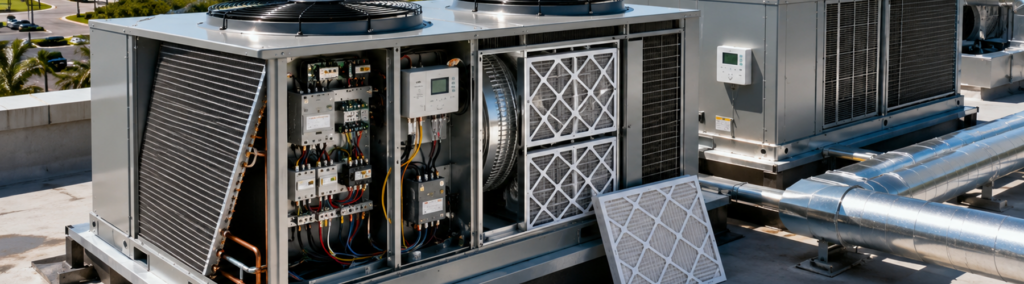
- A real commercial HVAC preventative maintenance visit covers filter changes, coil cleaning, refrigerant checks, electrical testing, and thermostat calibration at the unit.
- Florida’s heat and humidity push commercial systems harder than in most climates, which is why quarterly service is the general standard for Martin, St. Lucie, and Palm Beach County properties.
- Skipping maintenance doesn’t just raise your risk of a breakdown; it drives up energy bills, shortens equipment life, and can put manufacturer warranties and code compliance at risk.
- A structured, professionally managed maintenance plan protects your HVAC investment in a way that occasional, reactive repairs simply can’t.
If you own or manage a commercial building on the Treasure Coast, your HVAC system is quietly one of the most expensive pieces of equipment on the property. It also works harder here than in almost any other part of the country. Between the heat, the humidity, and the salt air rolling in off the coast, Florida’s climate puts constant strain on rooftop units, air handlers, and every component in between.
That strain is exactly why preventative maintenance matters so much for businesses in Martin, St. Lucie, and Palm Beach counties. A system that isn’t serviced on a set schedule doesn’t just risk breaking down at the worst possible time; it slowly costs you more in energy, repairs, and lost equipment life every month it goes unchecked. At Sharkey Air, we’ve been servicing homes and businesses across the Treasure Coast and we built our commercial maintenance programs around this exact reality.
This guide breaks down what a real preventative maintenance visit includes, how often your system actually needs it in Florida’s climate, and what it costs a business when that maintenance gets skipped.
What’s Included in a Commercial HVAC Preventive Maintenance Visit?
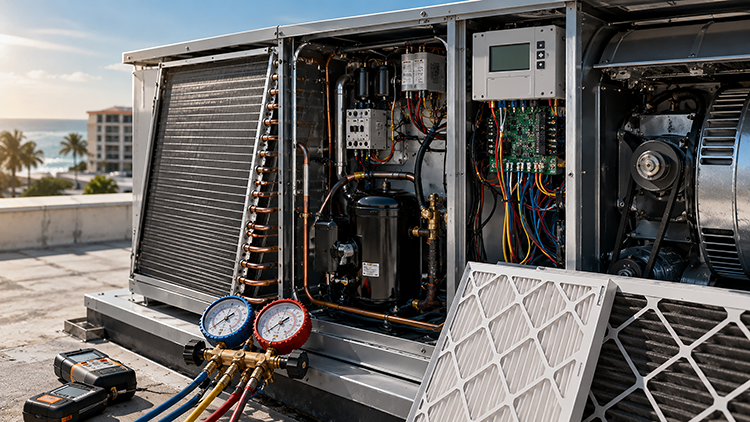
A proper commercial maintenance visit is a full system check, not a filter swap and a handshake. A qualified technician should be inspecting and servicing every component that affects comfort, efficiency, and safety, not just the parts that are easiest to reach.
A thorough visit typically includes:
- Filter changes: Clogged filters restrict airflow, force the system to work harder, and reduce indoor air quality for tenants, staff, and customers.
- Coil cleaning: Dirty evaporator and condenser coils reduce heat transfer, which means the system has to run longer to reach the same temperature.
- Refrigerant level checks: Low or improperly charged refrigerant strains the compressor and cuts cooling capacity, right when you need it most.
- Electrical testing: Loose connections, worn contactors, and failing capacitors are among the most common causes of sudden, unexpected shutdowns.
- Thermostat and control calibration: Miscalibrated controls cause short cycling, uneven temperatures, and wasted energy across the building.
- Belt and motor inspection: A worn belt or bearing is a simple fix during a scheduled visit; it’s a costly emergency call when it fails on its own.
Each of these tasks matters individually, but together they determine whether your system is actively protecting your building or slowly wearing itself down. That’s why every Sharkey Air maintenance visit ends with a digital summary detailing what was checked, what was serviced, and what to keep an eye on, so you have a clear record of your equipment’s condition after each visit.
How Often Does Your System Need Service in Florida’s Heat and Humidity?
Most commercial HVAC systems benefit from service on a quarterly basis, though the right frequency depends on your equipment, occupancy, and industry. A lightly used office suite and a busy restaurant kitchen don’t put the same wear on a system, even when the units themselves are identical.
High-demand environments, such as restaurants, medical offices, and any space with heavy foot traffic, often need more frequent attention to maintain performance and stay aligned with health and safety requirements.
Florida’s climate raises the baseline for everyone, though. Year-round cooling demand, combined with humidity that regularly climbs past 80 percent during summer mornings, means Treasure Coast systems rarely get an “off season” to recover the way equipment in milder climates does.
That constant demand is also why the efficiency payoff of maintenance is so significant here specifically. The U.S. Department of Energy notes that well-executed operations and maintenance programs can save organizations 5 to 20 percent annually on energy bills, and in a climate where cooling runs nearly year-round, that percentage adds up fast.
What Does Skipping Maintenance Really Cost Your Business?
It’s tempting to treat maintenance as an expense you can put off, especially when the system still seems to be running fine. The real cost of that decision usually shows up in ways that are easy to miss until they’re expensive to fix.
Breakdowns at the worst possible time
Most HVAC failures don’t happen out of nowhere; they build slowly from small issues (a failing capacitor, a slipping belt, a slow refrigerant leak) that go unnoticed without a routine inspection. Those issues tend to surface during the peak of summer, exactly when your system is working hardest and a breakdown hurts the most.
Higher energy bills than you should be paying
According to ENERGY STAR, space cooling accounts for roughly 15 percent of the electricity used in commercial buildings, second only to lighting. Neglected coils, dirty filters, and low refrigerant all force a system to consume more power to deliver the same amount of cooling, and that inefficiency shows up on every utility bill until it’s addressed.
Shortened equipment life
Running a system in poor condition, especially one already working overtime against Florida’s heat and humidity, adds unnecessary wear to compressors, motors, and controls.
Code and warranty exposure
Manufacturer warranties often require documented, regular maintenance to stay valid, and commercial buildings are frequently subject to inspection and code requirements tied to HVAC performance. Skipping service doesn’t just risk the equipment; it can put your warranty coverage and code compliance at risk at the exact moment you need them.
Why a Structured, Professionally Managed Plan Protects Your HVAC Investment
A single tune-up here and there isn’t the same thing as a maintenance plan, and the difference matters more in Florida than almost anywhere else. Reactive service catches problems after they’ve already cost you comfort, energy, or downtime. A structured plan is built to catch them before they do.
At Sharkey Air, we design commercial maintenance plans around your specific property, not a generic checklist. That means accounting for:
- Property type and usage: An office building, warehouse, school, retail space, or multi-tenant property all place different demands on an HVAC system, and a plan should reflect that.
- Equipment age and manufacturer specs: We evaluate your system’s age, type, usage, and service history before setting a schedule, so the plan matches your actual equipment instead of a generic interval.
- Local climate exposure: Properties in Martin, St. Lucie, and Palm Beach counties deal with a combination of heat, humidity, and coastal salt air that accelerates wear on outdoor units and electrical components alike.
Clients on a structured plan also get priority scheduling and reduced rates on repairs, along with a clear, documented history of every visit. That documentation matters for budgeting, for warranty claims, and for demonstrating code compliance if your building is ever inspected. It’s the difference between hoping your HVAC system holds up and knowing exactly where it stands.
Final Takeaways
- A maintenance visit is only as valuable as its scope; make sure filters, coils, refrigerant, electrical components, and controls are all being checked, not just one or two items.
- Florida’s coastal humidity and salt air add wear that most climates don’t, which is part of why a generic, one-size-fits-all schedule doesn’t hold up here.
- Documented service history protects more than the equipment; it protects your warranty coverage and your ability to demonstrate code compliance.
- Priority scheduling and repair discounts are meaningful benefits of a structured plan, especially during peak cooling season when service demand is highest.
- The businesses that avoid costly, disruptive breakdowns are almost always the ones treating maintenance as a schedule, not an afterthought.
Ready to Protect Your HVAC Investment?
Your HVAC system is too large an investment, and too central to your daily operations, to leave to chance. Whether you manage an office, a warehouse, a school, or a retail space anywhere in Martin, St. Lucie, or Palm Beach County, a structured maintenance plan helps reduce the risk of breakdowns, improve energy efficiency, and support the long-term lifespan of your equipment.
Sharkey Air has been serving homes and businesses across Florida’s Treasure Coast since 1989, and our commercial maintenance plans are built around your building, not a generic template. If it’s time to put a real plan in place, reach out to Sharkey Air to schedule a maintenance consultation and get a clear picture of exactly what your system needs.
Frequently Asked Questions
How often should commercial HVAC maintenance be performed in Florida?
Quarterly service is the general standard for most commercial properties in Martin, St. Lucie, and Palm Beach counties. High-demand spaces, like restaurants or medical facilities, often benefit from more frequent visits to keep pace with heavier use and stricter compliance needs.
Can preventative maintenance really lower our energy bills?
Yes. Since space cooling makes up a large share of commercial electricity use, keeping coils clean, refrigerant properly charged, and controls calibrated directly reduces the energy a system needs to maintain comfortable temperatures.
Does skipping maintenance affect my equipment warranty?
It can. Many manufacturer warranties require documented, regular maintenance to remain valid, so a missed service history can leave you without coverage exactly when you need a costly repair.
What types of commercial properties need a structured maintenance plan?
Office buildings, warehouses, schools, retail centers, and multi-tenant properties all benefit from a structured plan, since each one puts different demands on an HVAC system throughout the year.