Why Your Commercial Heating System in Palm Beach and Martin County Needs Year-Round Professional Maintenance
Key Takeaways
- Florida’s coastal humidity does not stop damaging your commercial heating system just because you are not using it. Nine months of idling in salt air accelerates corrosion, electrical degradation, and refrigerant stress.
- When temperatures drop on the Treasure Coast, businesses that skipped maintenance are the ones facing emergency failures, with technicians unavailable and tenants or staff left without heat.
- A planned maintenance program from a licensed local contractor like Sharkey Air goes far beyond filter swaps. It addresses the specific failure points that coastal idling creates.
- Getting onto a service schedule before the next cold snap is the single most reliable way to protect your building’s operations, your tenants, and your equipment investment.
Most business owners in Palm Beach and Martin County think of HVAC maintenance as something tied to summer. Get the cooling system checked before the heat hits, keep the filters clean, and call someone if something sounds wrong. That approach might work somewhere in the Midwest, where heating and cooling cycles follow a predictable rhythm. It does not work on Florida’s Treasure Coast.
Here, your commercial heating system may sit dormant for eight or nine months at a stretch. During that time, it is not resting. It is absorbing coastal humidity, collecting salt particles carried on Atlantic winds, and developing the kind of quiet deterioration that only reveals itself at the worst possible moment: the first genuinely cold night of the year, when you flip the heat on and nothing works.
This article is specifically for commercial property owners and managers in Stuart, Palm Beach County, St. Lucie County, and Martin County who want to understand what is actually happening to their heating equipment when they are not watching, why a professional maintenance program from a local contractor like Sharkey Air matters even in a warm climate, and how to get ahead of it before the next cold snap catches you off guard.
What Is Actually Happening to Your Heating System While It Sits Idle
This is the question most HVAC articles skip entirely, and it is the most important one for Treasure Coast business owners to understand.
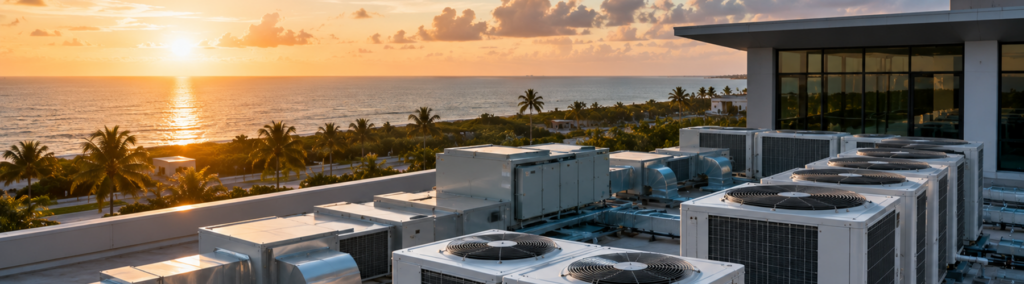
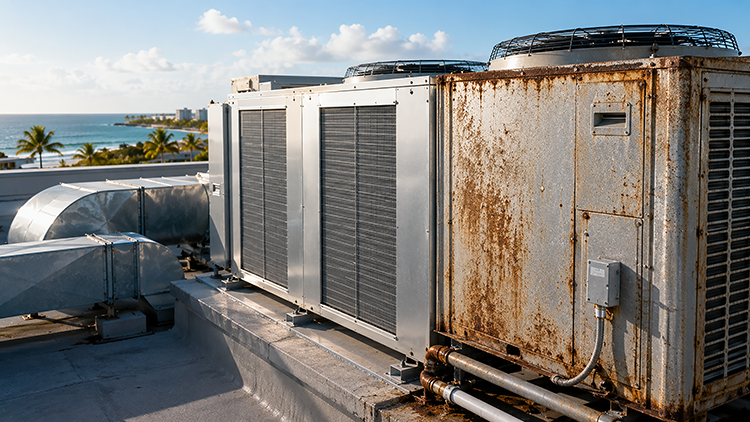
When your commercial heating system is not running through the summer months, its mechanical components are not in a neutral state. The outdoor units on your rooftop or alongside your building are continuously exposed to the coastal air environment.
Daily winds from the Atlantic Ocean carry fine salt particles that settle onto outdoor components and begin attacking metal surfaces almost immediately. Combined with Florida’s heavy humidity, this creates conditions where steel, aluminum, copper, and even fasteners are prone to rapid wear, with the cycle worsening after storms when windblown saltwater coats everything in its path.
Inside the system, lubricants in motors and compressors degrade over time without use. Electrical connections loosen or oxidize. Belts dry out and develop micro-cracks that are invisible until load is applied. Refrigerant lines that were under normal pressure in cooling mode face different thermal stress conditions when the system is suddenly called upon to run in heating mode during a cold snap.
When heating demand forces commercial systems into continuous operation, any component that was already weakening will likely fail under sustained load. When one part fails during peak operation, it often triggers problems in connected systems. A blower motor that overheats can damage the control board. A clogged filter that goes unnoticed creates pressure problems throughout the system.
The pattern is consistent: the failure does not happen gradually. It happens all at once, on the first cold night, when you need the system most.
Why Does Florida’s Coastal Climate Make Commercial Heating More Vulnerable Than You Think
Most commercial heating systems are engineered for environments where they run regularly throughout the year. Heating mode in December, cooling mode by March, with consistent operation keeping components lubricated, seals pliable, and electrical contacts clean.
On the Treasure Coast, that is not what happens. Your system might run in cooling mode from March through November, then sit essentially unused in heating mode for the remainder of the year, restarting only on the handful of genuinely cold nights that Florida gets. That irregular use pattern, combined with the coastal environment, creates a category of risk that most generic HVAC advice does not address. According to NOAA climate normals data published by the National Weather Service, the Tampa/South Florida region accumulates roughly 433 heating degree days per year compared to 3,611 cooling degree days, meaning commercial heating systems in this region face about 8 times more cooling demand than heating demand annually.
Corrosion does not just make a system look worn down. It actively reduces efficiency. The more a unit struggles to function properly, the harder it must work, leading to increased energy usage, frequent breakdowns, and a shorter lifespan overall. For commercial building owners, that translates directly into higher utility costs on top of repair expenses.
With proper commercial HVAC maintenance, systems often last 15 to 20 years. Without consistent service, Florida’s climate can significantly shorten equipment lifespan due to corrosion, humidity, and constant operational stress.
The financial case is straightforward. Poorly maintained HVAC systems can waste 15 to 30 percent of the energy they consume through duct leaks, dirty filters, and degraded components. For a commercial building where HVAC is the single largest energy expense, that is a high operational cost that compounds every month.
What Does a Professional Commercial Heating Maintenance Visit Actually Include
This is where the gap between a self-managed checklist and a professional inspection like the ones Sharkey Air conducts becomes most visible.
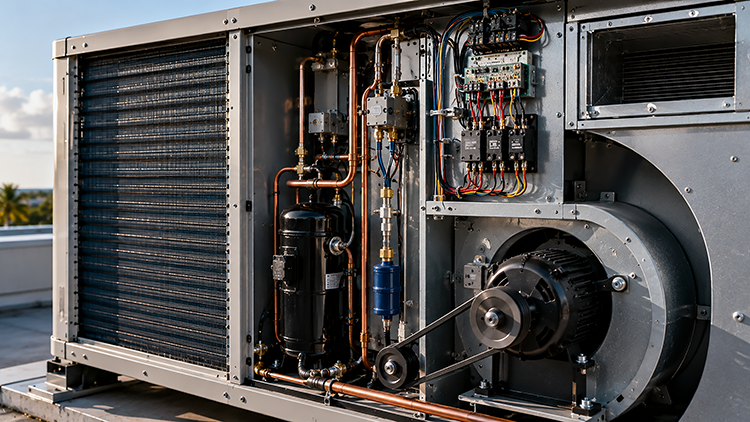
A business owner or facilities manager can check filters, visually inspect exterior units, and note whether the system is making unusual sounds. What they cannot do is evaluate refrigerant levels, assess compressor health, test electrical connections under load, inspect heat exchangers for cracks, or identify the early stages of coil corrosion before it causes a failure.
For commercial heating systems in a coastal Florida environment, professional maintenance typically covers the following areas.
Electrical system inspection
Terminals and contactors are examined for oxidation, looseness, and arcing. Loose terminals from vibration, worn contactors that arc and degrade, and sensors that drift in extreme weather are common failure points in commercial HVAC systems. These failures can go undetected for extended periods, wasting energy for months before anyone notices something is wrong.
Coil cleaning and corrosion assessment
Salt-laden air deposits on condenser coils reduce heat exchange efficiency significantly. A trained Sharkey Air technician can identify early corrosion and apply protective treatments before coil replacement becomes necessary.
Refrigerant level and pressure testing
Low refrigerant in a heating system operating in heat pump mode directly compromises output. This is not something visible without proper equipment.
Belts, motors, and mechanical components
Belts that have dried out over summer idling are a common failure point. Inspecting and replacing them as part of a scheduled visit costs a fraction of an emergency service call.
Controls and thermostat calibration
Commercial systems rely on precise sensor readings to maintain consistent temperatures across zones. Sensors that have drifted out of calibration waste energy and reduce comfort.
Condensate drainage
Standing water in drainage systems can affect air quality and structural components. Verifying clear drainage is a routine step that prevents a larger problem.
The difference between this kind of comprehensive visit and a basic filter change is the difference between finding a problem before it becomes a failure and discovering it at 11 PM on a January night when your tenants are calling.
Why Is a Self-Managed Maintenance Checklist Not Enough for Commercial Systems
There is a meaningful difference between residential and commercial HVAC maintenance, and it matters for how you approach the task.
Residential systems are simpler, typically serve a single zone, and are accessible for basic inspection by a homeowner with some mechanical awareness. Commercial systems serve multiple zones, operate under greater load, involve more complex electrical configurations, and in most cases sit on rooftops or in mechanical rooms where proper inspection requires licensed equipment and trained eyes.
For businesses near the coast, salt exposure accelerates corrosion on coils, electrical connections, and metal components, especially on rooftop units. Florida does not just use HVAC systems. It wears them down faster.
A checklist can prompt a facilities manager to change filters on schedule. It cannot prompt them to notice that a reversing valve in a heat pump system is showing early signs of failure, or that a heat exchanger has a hairline crack developing, or that refrigerant pressure has dropped just enough to cause inconsistent heating output on the next cold night. Those findings require a licensed technician with diagnostic equipment.
Beyond the technical gap, there is also a compliance consideration. Commercial buildings in Florida are subject to Florida Building Code requirements and in many cases to manufacturer warranty terms that specify licensed contractor service. A self-managed checklist may leave your building out of compliance without you realizing it.
Final Takeaways
- Your commercial heating system is being degraded by Florida’s coastal environment even when it is not running. Idling in salt air is not neutral.
- The failures that happen on the first cold night of the year are almost always the result of problems that were developing for months, silently, during the summer.
- Professional commercial HVAC maintenance is distinct from a self-managed checklist. The components most likely to fail in a coastal environment require licensed technicians and proper diagnostic equipment to assess.
- Getting onto a service schedule before winter demand arrives is the single most actionable step a commercial property owner in Martin County or Palm Beach County can take to protect their building and their tenants.
Running a commercial building in Florida’s Treasure Coast means managing an HVAC system that faces conditions most equipment was not specifically designed for. The combination of extended heating system idling and relentless coastal humidity creates a failure risk that does not get better on its own.
At Sharkey Air, we have been serving commercial properties across Martin County, Palm Beach County, and St. Lucie County since 1989, and we understand exactly how the local environment affects commercial heating equipment. Our commercial HVAC maintenance programs are structured around what your specific building and system actually need, not a generic checklist. If you want to get your heating system inspected and onto a reliable service schedule before the next cold snap, contact the Sharkey Air team and we will take it from there.
Frequently Asked Questions
How often should a commercial heating system be serviced in Florida?
Most commercial systems benefit from at least quarterly professional service visits. High-demand environments such as medical offices, restaurants, or multi-tenant properties may require more frequent attention. The specific frequency should be determined based on system age, equipment type, occupancy, and exposure to coastal conditions.
Does a commercial heating system in Florida really need maintenance if it only runs a few months a year?
Yes. The damage that leads to heating failures on the Treasure Coast accumulates during the months when the system is idle, not when it is running. Salt air corrosion, refrigerant stress, and electrical degradation happen continuously regardless of whether the system is in active use.
What is the difference between a service contract and a one-time maintenance visit?
A one-time visit addresses what is visible on that day. A service contract establishes a scheduled program with consistent inspection intervals, so that deterioration is caught before it reaches the failure stage. For commercial buildings, a structured contract also typically includes priority scheduling and repair discounts, which have direct value during high-demand periods like a cold snap.
What are the warning signs that a commercial heating system is approaching failure?
Uneven temperatures across zones, longer run times to reach the same setpoint, unusual sounds during startup, noticeably higher energy bills without a change in occupancy, and any visible corrosion on exterior components are all signs worth taking seriously. Any of these warrants a professional inspection before the next heating demand cycle.