AC Unit Fan Not Spinning? What It Means and What to Do Next
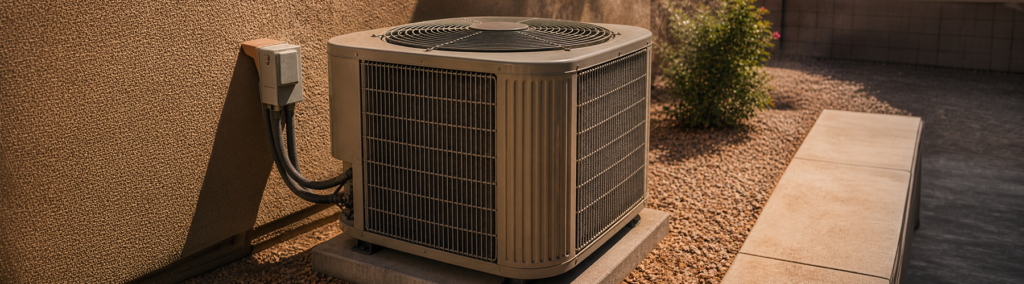
If your outdoor AC unit is running but the fan on top is not spinning, the most common cause is a failed capacitor, followed by a burned-out fan motor, a tripped breaker or a worn contactor. Turn the system off at the thermostat to protect the compressor, try the safe checks below, then call a technician.
You notice the outdoor AC unit is running. You can hear it humming. But when you walk outside and look at the top of the unit, the fan is completely still. That single observation tells you something is wrong, and your system is likely already working against itself trying to compensate. In Florida’s climate, an air conditioning fan that stops spinning is not a minor inconvenience. It is a warning that the system is heading toward a larger and much more expensive failure.
Sharkey Air has repaired AC systems on Florida’s Treasure Coast since 1989, and our technicians see stopped condenser fans in homes and businesses across Martin, St. Lucie and Palm Beach Counties. Here is how to read the symptoms and what each one means for your system.
What Does It Mean When Your AC Unit Fan Stops Spinning?
When the outdoor AC fan stops spinning, the sound the unit makes is the best clue. A hum with no movement usually points to the capacitor. Total silence usually means the outdoor unit is not getting power. Clicking points to the contactor or controls. Use the table below, then turn the system off and call a technician.
| What you notice | Most likely cause | What to do now |
|---|---|---|
| Unit hums, fan blades stay still | Weak or failed run capacitor; less often, seized motor bearings | Turn the system off at the thermostat. Do not push the blades. Call for service. |
| Compressor runs, but the fan does not | Fan side of a dual capacitor, a failed fan motor, or a wiring fault to the motor | Shut it off right away. This is the case that overheats the compressor fastest. |
| Outdoor unit is completely silent, indoor air still blowing | No power reaching the outdoor unit: tripped breaker, blown fuse in the disconnect, failed contactor, or no signal from the thermostat | Do the safe checks below (breaker, disconnect, thermostat). |
| Clicking when the unit tries to start | Worn or pitted contactor, a failing capacitor, or a control board problem | Turn it off and call. Repeated start attempts add wear. |
| Fan starts slowly, or runs a while and then stops | Capacitor losing strength, or a motor overheating and shutting itself off | Book a repair soon. This often turns into a full failure within weeks. |
| Grinding or scraping, or something visible in the top grille | Debris, a bent or loose fan blade, or worn motor bearings | Turn off power at the disconnect before clearing anything from outside the grille. |
| Whole outdoor unit shuts off and the house is warm | A safety switch tripped, sometimes from low refrigerant caused by a leak | Call for a leak check. Adding refrigerant without fixing the leak will not last. |
These are the patterns technicians see most often. A meter test is the only way to confirm which part failed, because a bad capacitor and a failing motor can sound alike.
What Should You Check First When the AC Fan Is Not Spinning?
Before calling, check the thermostat, the AC breaker and the outdoor disconnect switch. These take five minutes, need no tools, and explain a fan that is completely still and silent. Do not open the outdoor unit: the capacitor inside can hold a dangerous charge even with the power off.
-
Check the thermostat
Make sure it is set to Cool and a few degrees below the room temperature. If the display is blank, replace the batteries.
-
Check the AC breaker
At the electrical panel, find the AC breaker (usually a double breaker). If it has tripped, switch it fully off, then back on, once. If it trips again, leave it off and call.
-
Check the outdoor disconnect
Next to the outdoor unit is a small box with a switch or pull-out block. Make sure it is on and fully seated. Do not open anything else.
-
Look, do not reach
From outside the unit, look through the top grille for leaves, sticks or a bent blade. Turn the disconnect off before removing anything from outside the grille, and never put fingers or tools through it.
-
Turn it off and call
If the fan is still not spinning, set the thermostat to Off and switch off the disconnect. Running the system with a stopped fan can overheat the compressor.
Is it the outdoor fan or the indoor blower?
Your central AC has two fans. The outdoor (condenser) fan sits on top of the unit outside and releases heat. The indoor blower sits in the air handler and pushes cool air through your vents. If air is coming out of your vents but the outdoor fan is still, the problem is in the outdoor unit. If no air comes out of the vents at all, the indoor blower, the thermostat or the power to the air handler is more likely the cause.
Why Does the Fan in Your AC Unit Stop Spinning
The outdoor fan in your AC unit, also called the condenser fan, has one primary job. It pulls air across the condenser coil to release the heat removed from your home. When it stops spinning, heat builds up inside the unit. The refrigerant cannot release its heat load, pressure climbs inside the system, and protective sensors eventually force a shutdown. If those sensors fail or are bypassed, the compressor overheats.
There is rarely a single universal reason why fans stop spinning. The cause depends on the age of the unit, the condition of its components, how consistently it has been maintained, and how hard the system has been running in Florida’s heat. Most cases come down to one of several root causes, each with its own repair path and cost range.
What Is a Capacitor and Why Does It Fail So Often
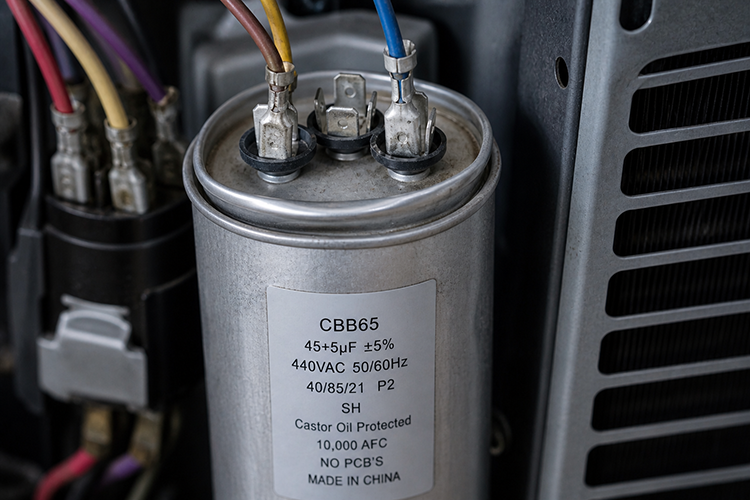
The capacitor is a small cylindrical component inside the outdoor unit that stores and releases electrical energy to start and run the fan motor. Think of it as the battery that gives the motor enough of a push to begin turning. Without it functioning correctly, the motor receives inconsistent power or no power at all. The fan may try to start, twitch, and stop. Or it may not attempt to move at all.
Capacitors are one of the most frequently replaced parts in residential and commercial AC systems, particularly in Florida. Heat degrades them faster than almost any other component. Every summer, Sharkey Air technicians replace dozens of failed capacitors across the Treasure Coast. The symptoms of a failing capacitor are usually pretty clear.
- The fan hums but does not spin
- The fan blades move if you give them a gentle manual push but immediately stop again
- The system short-cycles, meaning it turns on and off repeatedly without completing a full cooling cycle
- You notice the unit is running but your indoor temperature is not dropping
A capacitor replacement is typically one of the more affordable AC repairs when caught early. However, running the system with a failing capacitor forces the motor to draw more current than it is designed for. Over time, this burns out the motor windings, turning a minor capacitor repair into a full motor replacement.
Can a Bad Motor Be the Reason the Fan Stopped
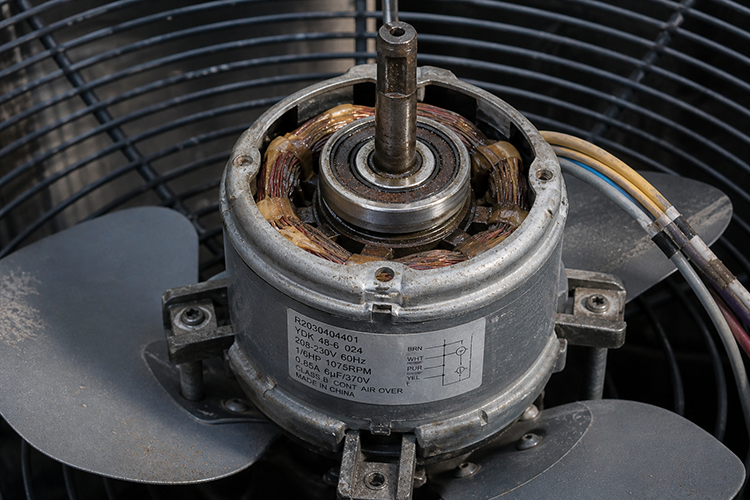
Yes, and this is the next most common cause we see. The condenser fan motor is an electric motor designed to run for thousands of hours, but Florida’s operating environment pushes motors to their limits. The combination of year-round use, high ambient temperatures, humidity, and occasional flooding during storm season shortens motor life significantly compared to units in cooler climates.
When a motor fails, it typically happens in one of two ways. Either the windings inside the motor burn out from heat or electrical stress, or the bearings seize from wear or contamination. A motor with burned windings will usually trip the breaker or cause the unit to stop entirely. A motor with seized bearings may still allow the system to appear to run while the fan stays completely still. Heat, humidity and long run times wear out motor bearings and windings faster. Outdoor units on the Treasure Coast run most of the year and sit in salt air near the coast, so condenser fan motors here tend to fail sooner than in cooler, drier climates.
Motor failure is a more serious repair than a capacitor replacement. In older systems, a failed motor often prompts a conversation about whether the cost of replacement makes sense compared to the age and overall condition of the system. Our technicians at Sharkey Air always give you an honest assessment rather than pushing unnecessary replacements.
Are Electrical Faults Behind a Fan That Will Not Turn On
Electrical issues are less common than capacitor or motor failure, but they do occur and they can be harder to diagnose without proper equipment. A fan that is not spinning due to an electrical fault may have a problem anywhere in the circuit that powers it. This includes the contactor, the control board, the disconnect, the wiring between components, or even a tripped breaker at the panel.
Contactors are high-voltage switches that close when the thermostat calls for cooling, completing the circuit to the outdoor unit. A worn or pitted contactor may fail to make proper contact, leaving the fan without power even though the rest of the system appears active. Control boards route signals from the thermostat to individual components. A failed board may simply stop sending the signal to run the fan.
One important note for homeowners: electrical faults inside an AC unit involve high-voltage components. The capacitor alone can hold a lethal charge even when the unit is powered off. Do not attempt to inspect or repair any electrical component inside the outdoor unit without the proper training and safety equipment. This is one of the primary reasons professional services are not just convenient but genuinely necessary.
How Does Low Refrigerant Relate to a Fan That Stops Spinning
Refrigerant and the fan are connected through the pressure dynamics of the system. When refrigerant levels drop due to a leak, the low-pressure switch inside the unit may trigger and shut down components to protect the system. Depending on the unit’s design, this can include the condenser fan. So in some cases, a fan that appears to have stopped may actually be a symptom of a refrigerant problem rather than a fan component problem.
Additionally, when the refrigerant is low and heat is not being transferred efficiently, the system runs longer and harder. This puts more thermal stress on the motor and capacitor, accelerating their wear. Refrigerant leaks must be located and repaired before recharging. Simply topping off the refrigerant without fixing the leak is a temporary measure that will not hold.
A system running with a compromised refrigerant charge or a failed fan is doing all of that work at a fraction of its designed efficiency.
How Much Does It Cost to Fix an AC Fan That Is Not Spinning?
The cost depends on which part failed and how long the unit ran without the fan. A capacitor is usually one of the less expensive AC repairs. A condenser fan motor costs more because it must match the unit’s voltage, horsepower, speed and rotation. A compressor damaged by overheating can cost close to a new system, which is why shutting the unit off early matters most.
What Happens to Your System When the Fan Is Not Spinning
This is the part many homeowners underestimate. Running an AC system with a non-spinning condenser fan does not just reduce cooling output. It actively damages the system. Without airflow across the condenser coil, heat has nowhere to go. Refrigerant pressure rises dramatically. The compressor works against escalating back-pressure and generates intense heat of its own.
Most modern systems have high-pressure cutoff switches that will shut the unit down before the compressor reaches a destructive temperature. But in older systems or units where sensors have degraded, the compressor may continue running into dangerous territory. Compressor replacement or failure often means the cost of repair approaches or exceeds the cost of a new system installation.
Can You Run Your AC With the Fan Not Working
We understand the instinct, especially in the middle of a Florida summer. The answer is no, and we want to be direct about that. Running the system with a non-spinning fan is not a workaround. It accelerates the damage to components that are already under stress. Every minute the compressor runs without condenser airflow is a minute of excessive wear you cannot undo.
If your fan has stopped, turn the system off at the thermostat and at the disconnect near the outdoor unit. Do not attempt to manually spin the fan blades with a stick or tool and then restart the system. This can sometimes get a weak motor or failing capacitor to spin momentarily, but it does not fix the underlying fault. More importantly, it creates a risk of electric shock and can cause the motor to draw an unsafe current surge.
While waiting for service, keep interior doors closed to retain whatever cool air remains in the home. Use fans to circulate air. Check on vulnerable family members, particularly the elderly and young children, who are more susceptible to heat-related illness. In commercial settings, activate your contingency cooling plan if one exists.
Why Should You Hire a Professional HVAC Technician
This question comes up frequently, and it deserves a complete answer. Replacing a capacitor may look straightforward in a video tutorial. The component itself is not expensive. But what those tutorials do not show you is the risk of stored electrical charge in the existing capacitor, the importance of matching the correct microfarad rating and voltage to your specific unit, or the secondary diagnostic steps needed to confirm the capacitor was actually the only fault.
Misdiagnosis is the most common outcome of DIY AC repair. A homeowner replaces the capacitor. The fan spins again. Three weeks later, the motor burns out because the real problem was a motor drawing excessive current due to bearing wear, and the new capacitor was simply masking the symptom temporarily. Now the homeowner has paid for a capacitor they did not need, and they are back to a non-working fan with a damaged motor.
A licensed HVAC technician from Sharkey Air brings several things a DIY approach cannot replicate.
- Calibrated electrical testing equipment to measure capacitor health, motor current draw, and voltage levels across the circuit
- Refrigerant handling certification, which is legally required and necessary for any diagnosis involving refrigerant pressures
- Direct access to manufacturer specifications for your specific unit model
- Experience in diagnosing the actual root cause rather than the most visible symptom
- Warranty on parts and labor, giving you protection if the repair needs follow-up
How Does Professional Repair Protect Long-Term System Performance
When Sharkey Air technicians respond to a fan-not-spinning call, the repair does not stop at swapping the faulty component. The visit includes a broader inspection of the system’s condition. We check refrigerant pressure, inspect the condenser coil for dirt or damage, test the contactor for pitting or wear, verify that the control board is sending correct signals, and assess the overall health of the motor and capacitor together.
This approach means you are not just fixing today’s problem. You are getting a clear picture of what may need attention in the next service season. In many cases, catching a second worn component during a fan repair visit prevents a mid-summer breakdown that would require emergency service at a premium cost.
For commercial customers throughout the Treasure Coast, unplanned downtime has a direct financial impact. A restaurant without AC during a lunch rush, a retail space that cannot cool to a comfortable shopping temperature, or an office where staff cannot work effectively are all situations that Sharkey Air understands urgently need resolution. Our commercial maintenance agreements are designed to keep systems running reliably before problems reach the emergency stage.
Final Takeaways
- The most common causes of a non-spinning AC fan are capacitor failure, motor failure, and electrical faults.
- Each cause requires a different repair approach, which is why accurate diagnosis comes before any parts replacement.
- Florida’s climate means AC components wear faster than in cooler regions, making annual maintenance especially important on the Treasure Coast.
- Running the system with a stopped fan risks compressor damage, which is one of the most expensive failures in any AC system.
A stopped fan is your AC system telling you something has broken down, and it rarely stays as a single isolated problem if you leave it unaddressed. The good news is that most of these repairs, when caught early, are straightforward for an experienced technician and do not require a full system replacement. The key is acting quickly, keeping the system off until service arrives, and getting a proper diagnosis from someone who knows what they are looking at.
Sharkey Air has been serving Florida’s Treasure Coast since 1989 with honest, reliable HVAC repair for both residential and commercial customers. Whether you need a fast capacitor replacement or a complete system assessment, our team has the experience and local knowledge to restore your comfort safely and efficiently. Visit our AC repair services page or reach out to our team today to get your system back where it belongs.
Frequently Asked Questions
Why is my AC fan not spinning but the compressor is running?
When the compressor runs but the outdoor fan does not, the usual causes are the fan side of a dual run capacitor, a failed condenser fan motor, or a loose or burned wire to the motor. Turn the system off right away, because the compressor overheats quickly without the fan moving air across the coil.
Which way should the outside AC fan spin?
On most home outdoor units, the fan pulls air in through the coil on the sides and blows it out through the top grille. If you can feel warm air rising out of the top while the unit runs, the fan is moving air the right way. A fan that runs but moves little air should be checked by a technician.
If I push the fan blades and they start spinning, is the problem fixed?
No. A fan that starts after a push almost always has a weak capacitor or a motor that is starting to fail, and it will usually stop again. Pushing the blades also puts your hand or a tool near moving parts and live wiring. Turn the system off and have the capacitor and motor tested.
Is the outdoor fan the same as the indoor blower?
No. The outdoor fan on top of the condenser releases heat outside, and the indoor blower in the air handler pushes cool air through your vents. If air still comes out of the vents but the outdoor fan is still, the problem is in the outdoor unit. If no air comes out of the vents, look at the indoor blower, thermostat or power to the air handler.